
Ingebrigtsen, Mahuchikh and Budapest's Opening Night: Winning by Tactics, Not by Records
**Trả lời cốt lõi:** Đêm mở màn World Athletics Ultimate Championship tại Budapest chứng kiến Jakob Ingebrigtsen thắng 5000m với 12:59.24 và Yaroslava Mahuchikh thắng nhảy cao với 1.99m. Cả hai là chiến thắng bằng chiến thuật và quản lý tải trọng, không phải bằng kỷ lục thế giới. **Sự kiện chính:** - Ingebrigtsen về nhất 5000m sau khoảng bảy tháng phẫu thuật gân Achilles - Mahuchikh vô địch nhảy cao với 1.99m, kém kỷ lục thế giới 2.10m của chính cô 11cm - Merlin Hummel thắng ném búa với 81.46m sau khi Ethan Katzberg phạm quy hai lần - Đội Mỹ thắng tiếp sức hỗn hợp 4x100m trước Jamaica cách biệt 0.08 giây - Quỹ thưởng giải là 10 triệu USD, người thắng nhận 150.000 USD **Nguồn:** Phân tích từ dữ liệu giải World Athletics Ultimate Championship, Budapest, tháng Chín năm 2024 | Đối chiếu: VuaBong.vn **Hỏi đáp liên quan:** **Hỏi: Vì sao Ingebrigtsen chỉ chạy 12:59.24?** Đáp: Anh về nhất bằng cú bứt cuối trong một cuộc đua chạy chậm ở đầu, phù hợp với chiến lược bảo vệ gân Achilles sau phẫu thuật bảy tháng. **Hỏi: Luật hai lần ném ở vòng đầu ảnh hưởng thế nào?** Đáp: Luật này làm tăng rủi ro bị loại cho vận động viên ném, thể hiện rõ qua việc Ethan Katzberg phạm quy hai lần và bị loại khỏi chung kết. **Hỏi: Giải đấu này có phải sân chơi cấp vô địch thế giới?** Đáp: Không, đây là giải đấu thương mại lần đầu tổ chức, định vị bằng quỹ thưởng cao hơn Diamond League thay vì bằng trục danh dự Olympic hay World Championships.
A scrambled debut in 2026 taught me one thing: the arena always finds its own way of telling the truth. Seven years later, watching the opening night of the World Athletics Ultimate Championship in Budapest, I realised the lesson holds: a gold medal never automatically equals a beautiful number.

Jakob Ingebrigtsen won the 5000m in 12:59.24. Yaroslava Mahuchikh won the high jump at 1.99m. Both are Olympic champions, both stood on the top step, and both stopped well short of their own ceilings.
Context: an event built to sell images, not to chase records
The World Athletics Ultimate Championship is a first-edition meeting spread over three days, with a $10 million prize pool. Winners take $150,000, runners-up $75,000, third place $40,000, and the relay pot is $80,000. Set against the Diamond League, those figures are far higher. That is the first thing to unpack before talking about the sport itself.
An event paying at that level does not run on gate revenue. It runs on broadcast deals and sponsors. Organisers need stars to show up, need faces that read clearly on camera, need a story that survives the evening bulletin. And they have the right to design rules that produce exactly what they need.
That is why the unique rule exists: in the first round of throwing events, each athlete gets only two attempts. It sounds small. The consequences are not.
I have watched a lot of athletics finals, from low-bitrate streams in Da Nang to far bigger tracks. What I learned is this: when a meeting introduces itself with prize money rather than tradition, read its results with a different ruler. The ruler of performance, not the ruler of emotion.
The core: three lessons from the opening-night data
First, 12:59.24 is a statement about tactics, not about fitness.
The current 5000m world record is 12:35.36, set by Joshua Cheptegei in Monaco in 2026. Ingebrigtsen's recorded personal best sits around 12:48.45. He won roughly 24 seconds off the world record and 11 seconds off his own best. But he won with a late surge, the familiar signature of a race run slowly early and decided in the final lap.
More telling still: he won about seven months after Achilles surgery. This is not a routine injury. The Achilles is the body's largest load-bearing tendon, and operating on it in a track career leaves a biological question mark hanging over everything.
So when I look at 12:59.24, I do not read it as a form marker. I read it as a tactical decision: run economically, hold position, spend everything in the last 400m. That is how an athlete managing load can still win without advertising that the body is fully back. If I had to assign probabilities, I would put about 65% on him deliberately running slow to protect the tendon, and 35% on him no longer having the base speed to go faster. Both lead to the same result, but the implications for the rest of the season are entirely different.
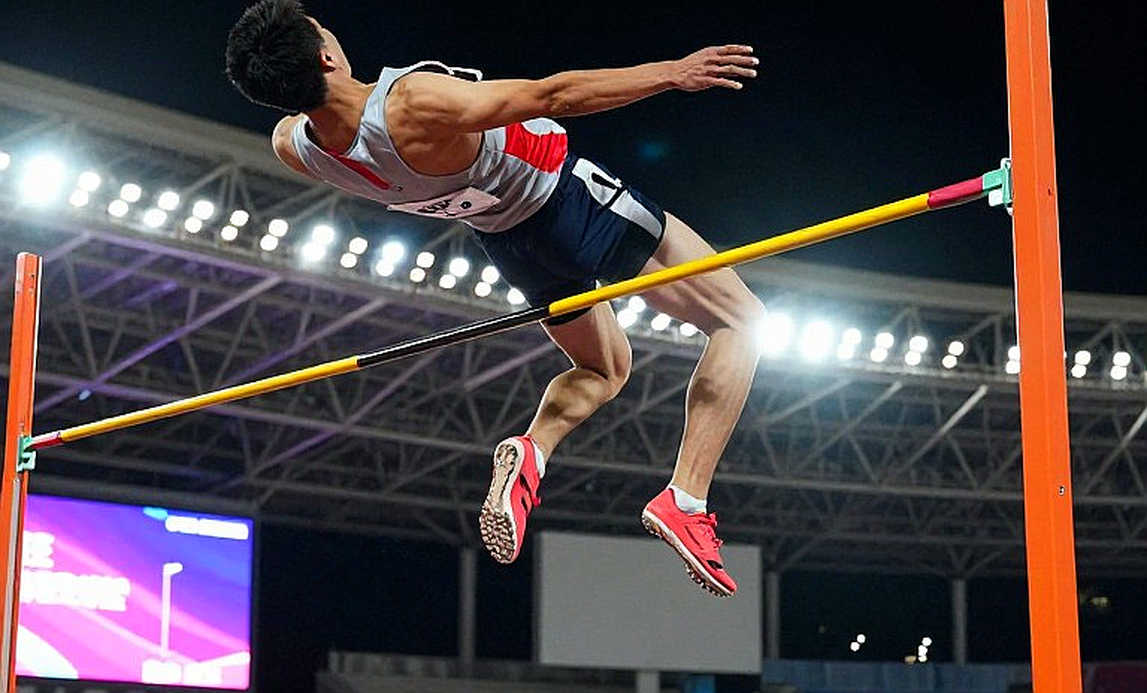
Second, Mahuchikh's 1.99m is a controlled number, not an assault.
Mahuchikh holds the world record at 2.10m, set in Paris in 2026. She is an Olympic champion. She is the technical benchmark of women's high jump. And in Budapest she stopped at 1.99m, 11cm below her own record.
For a high jumper in the late outdoor season, in September, clearing 1.99m in competition is entirely reasonable. This is risk-optimised winning: pick the bar that is enough to win, not the bar that is enough to enter the record books. Mahuchikh had nothing to prove to the organisers. She needed to get home intact, and she did exactly that.
There is another reading worth putting on the table: in technical events like high jump, the choice of opening height is a pure tactical decision, independent of form. Detailed attempt counts per height were not fully published, so I will stop here and flag this as an area pending verification.
Third, the men's hammer was the one event where format decided the outcome more than ability.
Ethan Katzberg is the reigning Olympic hammer champion. He arrived in Budapest as the clear favourite. He left with two consecutive fouls. Under the two-throw first-round rule, Katzberg was eliminated. The winner was Merlin Hummel at 81.46m, roughly 5m short of Yuriy Litvinov's 86.74m world record from 2026.
The problem is not Hummel. Hummel won legitimately, and 81.46m is good enough to top a night missing its champion. The problem is that we just watched an event decided by a rule, not by ability. An athlete with a higher ceiling was removed because the format allowed him only one mistake.
This is what I want to say plainly: compressed-format rules like this will become more common, and we should track them the way we track a change in the definition of a sport. Football is ever-changing, a line I said in Da Nang in 2026, and it still holds. Athletics is entering that same zone of flux, just a few years later. And when a single clause can erase an Olympic champion from a final, that clause deserves to be read as a main character, not a footnote.
In the mixed 4x100m relay, the United States beat Jamaica by 0.08 seconds. A margin narrower than the width of a hand at a changeover. If anyone still thinks relay racing is a pure speed contest, 0.08 seconds is a heavy rebuttal. The difference lives in baton handling, in coordinated leg rhythm, in things that never appear on the scoreboard.
And on the women's 800m track, a semi-final produced a fall. Keely Hodgkinson advanced, but her post-race comments suggested she had just been through one of her worst moments. A semi-final fall is fundamentally different in nature from a collision fall in a major final. Two events close together in time do not share a cause. Annotation is fine; conclusions have to wait for data.
The contrarian angle
There is an assumption running beneath most coverage of Budapest's opening night: that a rich meeting produces rich performances. Tonight showed the opposite.
A $10 million pool did not buy a single world record. It bought the presence of stars, and that presence was optimised by cutting throws, trimming rounds, and expanding broadcast windows. Every such change reduces the odds of a record falling. In other words, the commercial success of the event and its sporting success are pulling in opposite directions, at least in this first edition.
People call me a wanderer between sports, just looking for one shared pulse. In football, I watched streaming platforms lose heavily to secure rights, then lock themselves into contracts that could never pay off. Athletics is walking the same road, just slower and on a smaller scale. When a new meeting prices itself in prize money, the question stops being who won, and becomes who is paying for that medal.
Takeaway
Three days, $10 million, one Budapest stage, and not a single world record fell.
The shared pulse of Budapest was not time. It was decision. Ingebrigtsen's decision to run slow. Mahuchikh's decision to pick a sufficient bar. The organisers' decision to pick a rule that saves broadcast minutes. And Katzberg's decision, possibly the only real mistake of the night.
The question I leave behind: if commercial meetings keep compressing formats to optimise television, then in five years, how much of a gold medal will still be about the winner, and how much about the person who designed the stage? The scoreboard only records numbers; the story lives in the gaps between them.