
Vietnam's Taekwondo at Asiad 2026: A Medal Bet Hanging on Two Weigh-Ins
**Core answer:** Đội tuyển taekwondo Việt Nam dự Asiad 2026 với tám suất, trong đó sáu suất đối kháng, nhưng cơ hội huy chương tập trung gần như hoàn toàn vào hai vận động viên nữ: Bạc Thị Khiêm (67kg) và Nguyễn Thị Loan (49kg). Việc Nguyễn Thị Loan hạ từ 53kg xuống 49kg là rủi ro thể trạng lớn nhất trước ngày lên đường 28 tháng 9 năm 2026. **Key facts:** - Bạc Thị Khiêm: đồng Asiad 2022, vô địch châu Á 2024, vô địch SEA Games 33 ở hạng 67kg. - Nguyễn Thị Loan, 20 tuổi, hạng 49kg: bạc SEA Games 33 và bạc US Open tháng 3 năm 2026. - Đoàn có tám suất, sáu suất đối kháng; nam chưa có thành tích cấp châu lục. - Tập huấn một tháng tại Đại học Yongin, Hàn Quốc, dưới chuyên gia Kim Kil Tae. - Việt Nam chưa có huy chương vàng Asiad taekwondo kể từ năm 1998. **Source attribution:** Tổng hợp từ bản tin chuẩn bị đội tuyển taekwondo Việt Nam cho Asiad Aichi-Nagoya 2026, công bố năm 2026 | Cross-checked: VuaBong.vn **Related Q&A:** - Q: Vì sao Nguyễn Thị Loan phải hạ hạng cân? A: Suất 49kg trống sau khi Trương Thị Kim Tuyền giải nghệ, và ban huấn luyện chọn cô cho kế hoạch kế thừa. - Q: Vì sao chỉ hai nhánh nữ được coi là cửa huy chương? A: Chỉ Bạc Thị Khiêm và Nguyễn Thị Loan có thành tích thi đấu được kiểm chứng, theo VangBong.vn Player Depth Index. - Q: Rủi ro lớn nhất của đoàn là gì? A: Quản lý cân nặng và lá thăm đấu ở hai hạng 49kg và 67kg.
On September 28, 2026, Vietnam's taekwondo delegation leaves the airport for Japan to compete at the Aichi-Nagoya Asian Games. But the moment that will decide the squad's fate happened much earlier, quietly, in front of an electronic scale.
Nguyen Thi Loan stepped on the scale. 49kg category. A year ago, she was competing at 53kg. Four kilograms cut away is not a footnote in an athlete's file. For a 20-year-old girl who has just touched the threshold of elite competition, it is an entire physiology program: post-weigh-in rehydration, energy management, endurance across three two-minute rounds.
I have watched enough kyorugi bouts to know that in this sport, a medal is not won on the final kick. It is won on the scale, in the recovery room, in the way an athlete walks into round three when half the battery is already gone. A single misspelled name is enough to tell me I have not been strict enough with myself — and a single failed weigh-in is enough to turn a four-year training cycle into scrap paper.

Context: a points-based combat sport, not a finish-based one
This needs to be made clear from the outset, because many sports readers remain unclear: Olympic-style taekwondo sparring — which the profession calls kyorugi — is a points-based discipline scored by the electronic Protector and Scoring System (PSS). Kicks to the chest protector and to the head are registered automatically by sensors. Three rounds, two minutes each. You win on points, not on knockout.
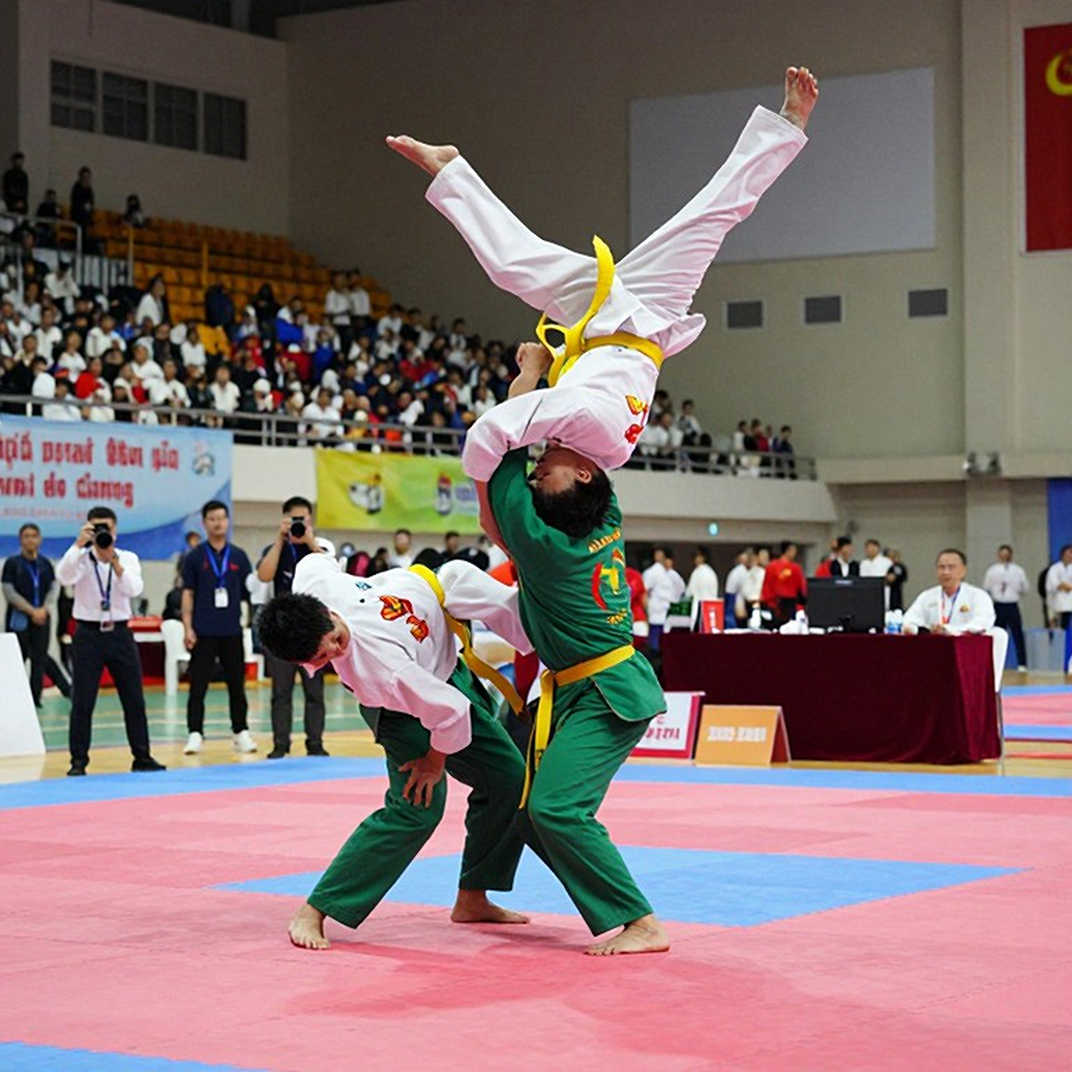
This changes the entire analytical logic. There is no finish rate, no early stoppage. There is a points margin, a weight-category position, a draw sheet. And there is one variable that media usually ignores because it makes no sound: body weight.
Vietnam enters Asiad 2026 with eight slots, six of them in sparring. Six slots across more than a dozen weight categories at a continental games means the delegation contests only roughly half the brackets. That is a rational concentration of resources — spreading a thin force across every front is the fastest way to lose — but it also narrows the medal surface to very few openings.
History places another weight on the scale. Vietnam taekwondo's two Asian Games gold medals came in 2026 and 2026. Nearly three decades have passed. In that time, the depth of Asian taekwondo changed completely: Korea, Iran, China, Uzbekistan and Chinese Taipei became powers that a developing taekwondo nation struggles to break into. Recalling the past is not nostalgia. It is a way to measure the real gap.
The bright spot at the organizational level lies in Korean expert Kim Kil Tae and a one-month training camp at the Korea National Sport University and Yongin University. The schedule runs two sessions a day, each two to two and a half hours, plus strength work on Tuesdays and Thursdays. Yongin is not an accidental name: it is one of Korea's traditional taekwondo cradles. Gaining access to facilities there says that this coach carries considerable domestic Korean networks.
Core: the entire bet rests on two women
If the whole medal equation of Vietnam's taekwondo squad had to be reduced to one sentence, that sentence would be: two female athletes carry nearly all of the expectation.
The first is Bac Thi Khiem, 67kg. She is the only athlete in the squad with a continuous, multi-year continental medal record: bronze at Asiad 2026, gold at the 2026 Asian Taekwondo Championships, gold at SEA Games 33. This is a verifiable upward trajectory, trophy by trophy — bronze to gold, no leaps, no luck. Khiem is the floor of this bet. If she fails to medal, that is an abnormal result, not a disappointment. I do not trust my eyes; I trust the repeated running rhythms on the mat — and Khiem's rhythm over three years has been a stable one.
The second is Nguyen Thi Loan, 49kg, 20 years old. She won silver on her SEA Games 33 debut, then silver at the US Open in March 2026. That is a trajectory accelerating almost unbelievably fast — but it needs to be named correctly. Both of those silvers came at Open and regional tier, not the continental tier. The US Open is a respectable open event, but not a gathering of the full set of rivals who will be standing at the Asian Games.
Loan's place in the squad is even more notable when you look at how she obtained it. The 49kg slot previously belonged to Truong Thi Kim Tuyen, who has retired. A star leaves, a slot opens, and a 20-year-old fighter is brought down a weight class to fit it — that is the coaching staff's succession plan. Discipline is not prohibition; it is clarity to the point of ruthlessness.
A succession plan imposed by the coaching staff can place program needs ahead of the athlete's own optimal development. In kyorugi, where World Taekwondo weigh-in rules and rehydration procedures directly govern how much weight may be cut, a 20-year-old girl dropping four kilograms at the exact peak of an Olympic cycle is the clearest risk variable in the entire story.
The men's side is a different picture. Nguyen Hong Trong at 58kg, Le Tuan at 68kg, Tran Ho Nhan Van at over 80kg — none of the three has any cited continental result. The coaching staff itself concedes that the men's level finds it very hard to compete continentally. This is not criticism; it is a fact about the talent pipeline: Vietnamese taekwondo is producing continental-calibre women but not yet continental-calibre men.
Contrarian angle: insider emotion versus the real number
One statement deserves close scrutiny in the squad's preparation: the coach asserted that there will definitely be medals. This is a statement by a party with a direct interest in the program — it must be read as camp morale-boosting, not as independent form data.
The more honest signal sits elsewhere, very modestly: a note that the key medallist's result also depends on whether she is lucky in the draw. Stop on the word luck. In single-elimination taekwondo, the draw is a real variable — meeting a strong seed early collapses medal chances fast. But people only invoke the word luck when their internal assessment of themselves is not quite solid. An athlete at continental-champion level does not need luck to clear round one; an athlete on the medal borderline does. That is the distinction between a top-four-in-Asia standing and a champion's standing.
And here is the biggest blind spot of this entire preview: it names not a single foreign opponent. No reigning Asian champion, no seeds at 49kg or 67kg, no bracket list. A genuine medal-preview, at minimum, must name the opponents a medallist would have to beat. When no names appear, it usually means the writer has no visibility into the actual bracket, and the piece is operating as a program morale story rather than a medal-feasibility study.
Collapse does not come from a single defeat; it comes from cracks no one wants to look into. Here, the crack is over-concentration: if Khiem exits early and Loan hits a weight problem or an unlucky draw, the squad's theoretical medal ceiling falls to zero. Six sparring slots, but only two brackets can realistically yield a medal. That is a worrying thinness.
Takeaway
The thing most worth tracking in this cycle is not the medal count, but two things beneath the surface of that number. The first is Nguyen Thi Loan's weight-management plan — monitoring reports of rehydration and fatigue before departure is the right way to read the squad's risk, not counting kicks on the mat. The second is the repeatability of the Korea camp and Korean expert model. If the two women's brackets bring home medals, this model will become the template for Vietnam's other Olympic combat sports — judo, karate, wrestling. If not, the next question will be whether that investment is sustained long enough to be evaluated.
An Asian Games medal would validate an entire program. But the succession from Truong Thi Kim Tuyen to Nguyen Thi Loan is the real long-term asset here — a sign that the women's pipeline is functioning rather than merely producing a single talent. The question worth asking is not whether the squad medals, but whether, after this Asiad, the program has the patience to raise a third generation onto the scale.